
Corporate social responsibility has become a fixture in the communications of companies across every sector. In real estate, it appears with particular regularity, in sustainability reports, in community engagement programmes, in charitable donations and environmental pledges. But the gap between CSR as communication and CSR as genuine practice is large, and the distinction matters, both for the communities that are affected by it and for the long-term integrity of the businesses that claim to practise it.
For a real estate group operating across island communities like those of Mauritius and La Réunion, communities that are geographically defined, culturally distinctive, and in which the impact of large-scale property development is felt directly and personally, this distinction is particularly important. What does meaningful CSR actually look like in this context?
Why Island Communities Demand a Different Approach to CSR
Island communities have characteristics that distinguish them from urban or rural communities in continental settings, and these characteristics shape what CSR should look like in an island context. Island communities are physically bounded, there is no adjacent territory to absorb the impacts of development activity. They are culturally cohesive, social networks are dense, reputations travel quickly, and the relationship between businesses and communities is more personal and direct than in larger, more anonymous settings.
Island communities also face specific vulnerabilities, to economic concentration, to environmental degradation, to the displacement effects of tourism-driven development on local residents. A real estate group operating in these communities that does not engage seriously with these vulnerabilities, that treats CSR as a peripheral activity, will eventually face the consequences in the form of reputational damage, regulatory pressure, and community resistance to future development.
The Local Employment Dimension
One of the most direct and meaningful forms of CSR for a real estate developer operating in island communities is a commitment to local employment, giving priority to hiring local contractors, workers, and suppliers wherever this is possible and reasonable. This commitment has multiple dimensions: it provides economic opportunity for local people, it builds the skill base in the local construction and real estate industry, and it creates a sense of shared benefit from development activity that builds community goodwill.
For the Apavou Group, which has operated in Mauritius and La Réunion across decades, local employment has been a consistent practice rather than a policy aspiration. The group’s long-term relationships with local contractors and service providers reflect this commitment, and they have generated mutual loyalty and operational reliability that benefits the business as well as the community.
Skills Development as Long-Term CSR Investment
Beyond direct employment, investment in skills development, through apprenticeship programmes, technical training, and partnerships with local educational institutions, represents CSR that creates lasting value for communities. A developer who helps train the next generation of construction workers, project managers, and real estate professionals is creating community capacity that persists well beyond the lifetime of any individual project. This kind of CSR is genuinely impactful because its effects compound over time.
Environmental CSR, Going Beyond Compliance
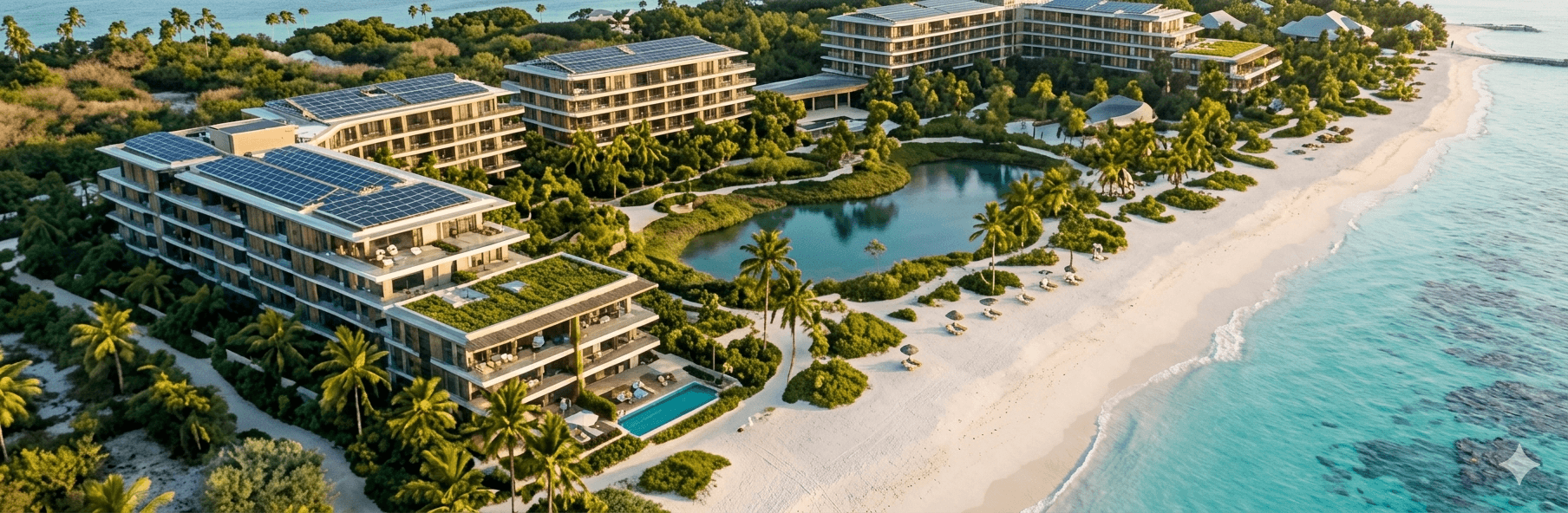
In island environments, the relationship between development activity and environmental quality is particularly direct. The natural environment, the coastlines, the reefs, the lagoons, the forests, is both the primary source of the island’s attractiveness and a fragile system that can be damaged, sometimes irreversibly, by poorly managed development. For a real estate developer operating in these environments, the environmental dimension of CSR is not optional, it is fundamental.
Meaningful environmental CSR in this context means going significantly beyond regulatory compliance. It means commissioning environmental impact assessments that are thorough rather than formulaic. It means implementing construction practices that actively protect adjacent natural systems rather than simply avoiding their destruction. It means designing buildings that are energy-efficient, water-conserving, and appropriate to their climate and environment. And it means maintaining the natural character of development sites to the greatest extent possible, rather than treating the natural environment as an obstacle to be overcome.
Marine Environment Protection in Coastal Development
Coastal development in Mauritius, where the reef and lagoon system is both an ecological asset of global significance and a primary driver of the tourism economy that supports property values, carries specific environmental responsibilities. Construction activities near the coast must be carefully managed to prevent sedimentation and chemical runoff that can damage reef systems. Seawall and coastal infrastructure design must account for the natural coastal processes that maintain beach and reef health. Wastewater management must ensure that treated effluent does not degrade the coastal water quality.
These are not simply regulatory requirements, they are expressions of genuine environmental stewardship that protect the natural assets on which the entire island economy, and therefore the real estate market, ultimately depends.
Community Engagement That Goes Beyond Consultation
Effective CSR requires genuine engagement with communities, not as a box-ticking exercise that precedes predetermined development decisions, but as a meaningful process that shapes how development happens and what it delivers. This means involving communities early in the planning process, before decisions are made. It means listening seriously to community concerns and being genuinely willing to modify plans in response. It means being transparent about what is being built, for whom, and on what terms.
For developers with a long-term commitment to the communities in which they operate, and the Apavou Group’s multi-decade presence in Mauritius qualifies as exactly this, this engagement is not onerous. It is a natural expression of relationships that have been built over years and that create a foundation of mutual trust.
Access to Quality Built Environment as a CSR Objective
One of the most powerful contributions that a real estate developer can make to a community is the creation of high-quality built environments that enhance the daily lives of the people who live and work in them. This means not only building to high specifications in the premium market but ensuring that the built environment created by the group’s activities, including the public realm, infrastructure, and community facilities that accompany development, is of quality that serves and uplifts the community.
Development that creates enclaves of quality disconnected from the surrounding community fails the basic test of meaningful CSR. Development that raises the quality of the entire neighbourhood, through improved public spaces, better infrastructure, and the creation of community facilities, is CSR in its truest form.
Measuring and Reporting CSR Performance
For CSR to be meaningful rather than aspirational, it must be measured and reported against clear, verifiable commitments. Vague statements of good intention, commitments to ‘supporting communities’ or ‘respecting the environment’, are not sufficient. Meaningful CSR reporting specifies targets, tracks performance against those targets, and reports honestly when targets are not met as well as when they are.
For real estate groups operating across multiple jurisdictions, like the Apavou Group, with its presence in both Mauritius and La Réunion, CSR reporting should reflect the specific context of each community rather than applying a generic framework. The environmental priorities in a coastal Mauritian community are different from those in an urban Réunion context, and the CSR framework should reflect these differences.
CSR as Identity, Not Addition
For a real estate group with genuine roots in island communities, CSR should not be an add-on, a separate programme that runs alongside the core business. It should be an expression of the values that define the business: the commitment to quality, the respect for community, the orientation toward the long term, and the recognition that the business’s success is inseparable from the wellbeing of the communities in which it operates.
This is what meaningful CSR looks like for Apavou CSR and for the Apavou Group more broadly: not a policy document or a charitable fund, but a daily practice embedded in how we build, how we manage, how we employ, and how we engage with the communities of Mauritius and La Réunion. It is how we honour the trust that these communities have placed in us over decades, and how we ensure that the trust of the next generation is earned in turn.
 Previous Post
 Next Post