

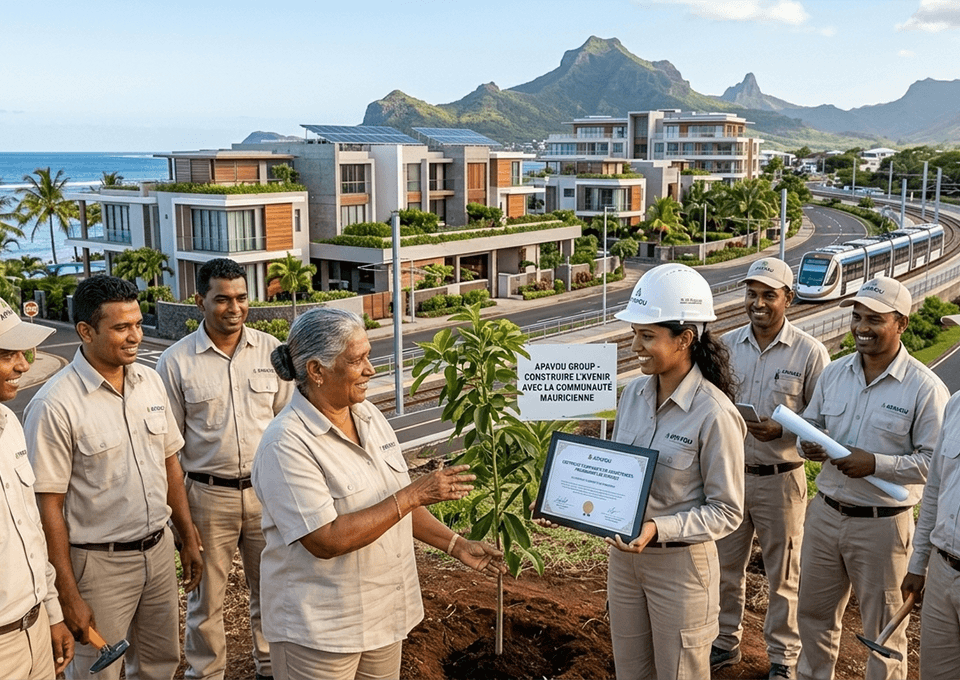
When a major real estate development project is completed in Mauritius, whether it is a commercial centre like Plaisance Mall, a residential development like Terre d’Été, or a mixed-use complex like The Cube, the visible output is the built asset: the buildings, the infrastructure, the public spaces, the commercial and residential environments where economic and community life will unfold. But behind that visible built output is an invisible output that is equally significant in its long-term impact: the economic value that has been created and distributed through the employment of local people in the planning, design, construction, and ongoing operation of the development.
Local hiring policies, the practices, commitments, and cultural orientations that determine where a developer looks for labour, what proportion of employment is offered to residents of the local community versus imported workers, and how investment in local skills development is managed throughout the development process, are among the most direct determinants of whether development activity in Mauritius creates broad social value or primarily transfers capital to outside interests. For the Apavou Group, founded by Armand Apavou with roots in the communities of both La Réunion and Mauritius, this social dimension of development is not a supplementary consideration. It is integral to how the group has understood its role in the island communities where it has built for over four decades.
The Mauritius Labour Market Context
Understanding why local hiring matters in the specific Mauritius context requires a clear picture of the island’s labour market characteristics. Mauritius has a working population of approximately 600,000 people in a total population of around 1.3 million. The construction and real estate sector is a significant employer within that workforce, and the skills available in the local labour market span a meaningful range, from construction labourers and tradespeople to experienced project managers, quantity surveyors, architects, civil engineers, and property and asset management professionals.
However, the supply of highly skilled professionals in some specialist areas of construction and real estate management can be genuinely limited by the scale of the local market, creating a real tension between local hiring aspirations and project quality requirements. This tension must be acknowledged honestly in any serious discussion of local hiring policy. A development group that commits unconditionally to 100% local employment regardless of skill availability makes a commitment it cannot keep without compromising project quality and delivery reliability. A group that uses skill shortage as a blanket and largely unexamined justification for importing labour at most levels is failing to invest in the development of local capability that would reduce this gap over time. The responsible and sustainable position lies between these extremes.
The Apavou Group’s Local Employment Approach in Mauritius
The Apavou Group’s development activity in Mauritius has, over more than four decades, created substantial local employment at every level of the development and property management value chain, from the construction workers who build the group’s projects to the architects and engineers who design them, from the commercial property managers who operate assets like Plaisance Mall and The Cube to the residential management and maintenance staff who serve communities like Terre d’Été. A large and consistent proportion of this workforce has been drawn from the Mauritius community.
This track record of local employment is not primarily the product of a formal policy framework, it reflects a business orientation that naturally gravitates toward local solutions wherever these exist at the required quality level. Partly because local hiring offers real cost efficiency and logistical advantages in an island environment. Partly because local workers bring specific knowledge of the Mauritius context, its climate, its materials, its regulatory requirements, its community sensitivities, that imported labour cannot readily replicate. And partly because of the genuine commitment of the group’s leadership, shaped by Armand Apavou’s long personal connection to these island communities, to contributing meaningfully to the economic wellbeing of the places where the group builds.
Construction Phase Employment, Where Local Hiring Creates the Greatest Social Impact
The construction phase of a major development project like Plaisance Mall, The Cube, or Terre d’Été is typically where the largest volume of employment is generated and where local hiring has the greatest potential social and economic impact. A major commercial or residential development in Mauritius can employ hundreds of workers directly during its construction phase, in construction trades, in project management, in professional consultancy, and in the supply chain of materials and construction services. The proportion of this employment that is local, versus imported from other countries, as is common in the construction sectors of some Indian Ocean island markets, directly determines how much of the project’s economic value circulates within the Mauritius economy versus being repatriated abroad as wages and profits of non-resident workers.
Skills Development as the Long-Term Dimension of Local Hiring Policy
Local hiring policy creates its greatest and most lasting social value when it is accompanied by genuine, sustained investment in local skills development. Hiring local workers for unskilled roles while systematically importing expertise for all higher-value and higher-skill functions may satisfy local employment statistics numerically, but it fundamentally misses the opportunity to build the local professional and technical capacity that creates long-term economic value and enables increasing local participation in the full range of development functions across future projects.
For the Apavou Group, investment in skills development, through participation in apprenticeship frameworks, support for technical training institutions on the island, mentoring relationships between experienced professionals and their local counterparts, and deliberate internal promotion pathways that advance capable Mauritians into senior roles across the group’s operations, is a dimension of local hiring policy that creates lasting community value extending well beyond the specific projects in which it occurs. The engineers, project managers, property professionals, and commercial managers who develop their capabilities through sustained engagement with the Apavou Group’s Mauritius operations are assets of the island’s real estate industry more broadly, not just of the group.
Procurement and the Supply Chain Dimension of Local Economic Impact
Local hiring policy is one important dimension of a broader commitment to local economic participation that also includes procurement policy, the choices about where goods and services required for development projects are sourced. Local procurement, giving genuine preference to Mauritius-based suppliers of construction materials, equipment, professional services, and operational supplies wherever this is commercially reasonable and quality-appropriate, creates employment and economic value throughout the Mauritius economy, extending the social footprint of development activity well beyond the directly employed workforce.
For a development group operating at the scale of the Apavou Group across projects like Plaisance Mall, The Cube, and Terre d’Été, the procurement decisions across a major development programme represent a significant economic injection into the local economy. The extent to which this injection is captured by Mauritius-based businesses or flows offshore through international procurement channels directly determines a significant portion of the project’s total social and economic footprint. Deliberate local procurement policy, not as a regulatory compliance exercise but as a genuine commitment to maximising local economic value creation consistent with project quality requirements, is a natural and reinforcing complement to local hiring policy.
Measuring and Reporting the Social Footprint of Local Hiring
For local hiring commitments to be meaningful rather than aspirational, they must be measured against specific, verifiable targets and reported honestly against those targets, including when targets are not met as well as when they are exceeded. Vague statements of commitment to local employment are insufficient. Meaningful measurement tracks the proportion of direct employment that is filled by Mauritius residents at each skill level across the project’s lifecycle, the investment made in structured skills development programmes and the measurable outcomes of that investment, the proportion of procurement spend that flows to Mauritius-registered and Mauritius-operating businesses, and the gender and socioeconomic diversity of the local workforce engaged.
This measurement discipline transforms local hiring from a rhetorical commitment into an operational accountability, one that can be tracked, improved over time, and reported to communities, authorities, and the public in a credible and transparent manner. For the Apavou Group, this accountability orientation toward local employment and social contribution reflects the group’s broader commitment to being a genuinely responsible participant in the Mauritius community, not merely a developer of physical assets but a long-term contributor to the social and economic fabric of the island.
Hiring Locally Is Building Community
For a real estate developer in Mauritius with genuine roots in the island’s community, local hiring is not simply an employment policy or a CSR programme component. It is a community-building practice that expresses, through every worker employed, every professional developed, every local supplier engaged, an investment in the capacity and prosperity of the community in which the group operates. This investment, accumulated across four decades of development activity in Mauritius by the Apavou Group, is one of the deepest and most durable forms of social value that a developer can create, and it is one of the most important dimensions of the social footprint that defines whether a development group is a genuine contributor to the communities it serves or merely a capital allocation vehicle that extracts value from them. For Armand Apavou and the Apavou Group in Mauritius, the answer has always been unambiguously clear.
 Previous Post
 Next Post