

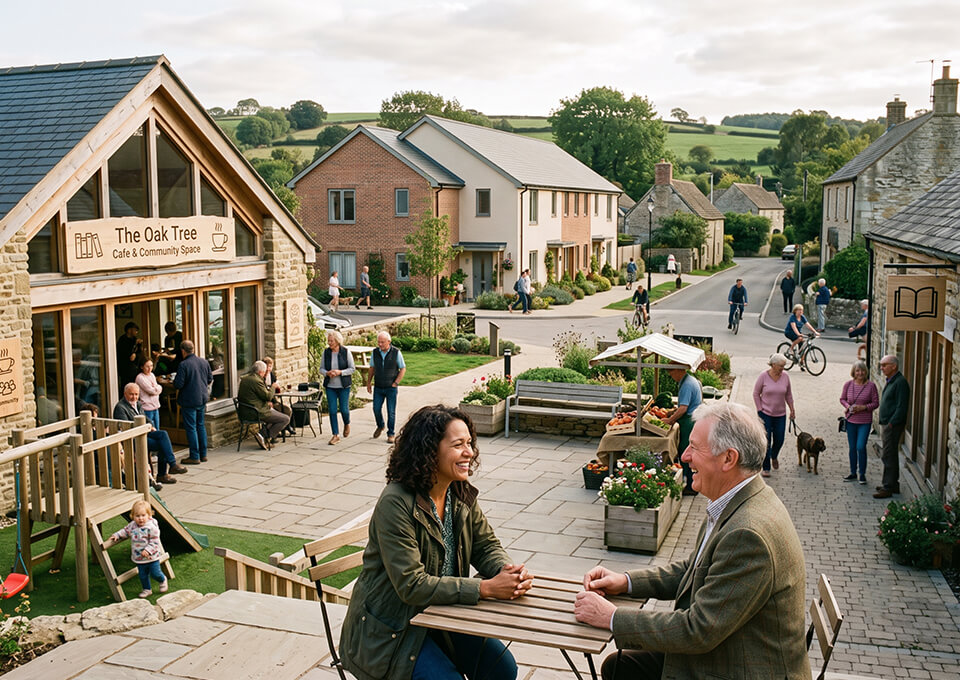
The financial return on a real estate investment is measured with relative precision: rental income, capital appreciation, total return on equity, and internal rate of return. These metrics, whatever their limitations, provide a quantifiable picture of the investment’s performance that can be compared, benchmarked, and tracked over time. The social return on a real estate investment, the value created for the communities in which the investment is located, for the workers employed in its construction and operation, for the people who live and work in and around the assets created, is far more difficult to measure with comparable precision. But this difficulty of measurement does not diminish the reality or the importance of social value. It simply requires a different analytical approach.
For a real estate group with deep roots in island communities like the Apavou Group, founded by Armand Apavou and operating across Mauritius and La Réunion for more than four decades through developments including Plaisance Mall, Terre d’Été, and The Cube, the question of how to measure and communicate the social return on its investment activities is both a governance imperative and a genuine strategic concern. Understanding the social value the group creates is essential to managing it well, to communicating it credibly, and to making future investment decisions that maximise both financial and social returns.
Why social return measurement matters for Mauritius real estate groups
The Mauritius government, through its Corporate Social Responsibility (CSR) framework and through the social impact requirements attached to major development approvals, has created a regulatory context in which social return is not simply an optional consideration but a formal dimension of how major real estate projects are evaluated and authorised. The CSR levy, requiring companies above a certain income threshold to invest a proportion of their taxable income in approved community development activities, is the most direct expression of this framework, but it is complemented by the growing expectation in the regulatory and planning process that major developments demonstrate a positive social impact case.
Beyond regulatory compliance, the business case for understanding and maximising social return is compelling for a real estate group with the Apavou Group’s long-term community presence in Mauritius. The group’s sustained ability to develop new projects, to maintain the social licence that allows it to operate effectively across the island, and to build the community relationships that provide competitive advantage in a market as relationship-intensive as Mauritius real estate all depend in part on the quality and authenticity of the social value the group creates through its activities. Measuring this social value, understanding what it consists of, how large it is, and how it can be maximised, is therefore not just a CSR communication exercise. It is a strategic management discipline.
The components of social return in Mauritius real estate development
The social return generated by real estate development activity in Mauritius can be decomposed into several distinct categories, each of which can be assessed and, to varying degrees, quantified. Employment creation, the jobs created both during construction and in the ongoing operation of completed developments, is typically the largest and most directly measurable component. Each major development by the Apavou Group creates hundreds of construction-phase jobs and sustains ongoing employment in asset management, property services, tenant businesses, and related supply chains. The total employment impact, including direct, indirect, and induced effects through the broader economy, is substantial.
Skills development, the investment in training local workers in construction trades, management capabilities, and technical skills, creates human capital that persists beyond the specific project and contributes to the island’s long-term productive capacity. For the Apavou Group, the investment in local workforce development through its construction programme across Plaisance Mall, Terre d’Été, The Cube, and other developments represents a cumulative contribution to the island’s skills base that is difficult to quantify precisely but is clearly significant in aggregate.
Community infrastructure and public good creation
Real estate developments in Mauritius often create community infrastructure and public goods that extend beyond the direct commercial assets being developed. Public realm improvements, landscaped areas, improved pedestrian access, public parking, and enhanced streetscapes, adjacent to commercial developments like Plaisance Mall, improve the quality of the urban environment for the wider community, not just for tenants and visitors of the specific development. The provision of community facilities, whether formal requirements of the planning consent or voluntary contributions, adds further direct social value. Quantifying these public good contributions requires assessment of the market value of equivalent provision if it had to be funded through alternative means.
Social return on investment, a framework for measurement
Social Return on Investment (SROI) is an established methodology for measuring and communicating the social value created by an organisation’s activities relative to the inputs invested. Applied to real estate development in the Mauritius context, SROI analysis involves identifying the full range of social value created by the development, employment, skills development, community infrastructure, environmental improvement, cultural contribution, and other relevant categories, assigning proxy financial values to each category based on the best available evidence of what equivalent value would cost or what it would be worth to those who benefit from it, and then calculating the total social value created as a ratio of the investment that generated it.
For the Apavou Group’s Mauritius developments, a comprehensive SROI analysis would likely reveal a substantial ratio of social value to financial investment, reflecting the cumulative community benefits of four decades of quality development activity on the island. Documenting and communicating this social return is not just a reputational exercise: it provides the evidence base for strategic decisions about how to maximise social value in future development decisions, and it contributes to the group’s ability to maintain the social licence that underpins its continued capacity to develop effectively in the Mauritius market.
The challenges of social value measurement in Mauritius
Measuring social value in the Mauritius context presents several specific challenges that must be acknowledged and managed carefully if the resulting analysis is to be credible and useful. The most fundamental is attribution, distinguishing the social value created specifically by the real estate development from the social value that would have been created in the absence of the development through other economic activity. In a growing economy like Mauritius’s, some employment creation and economic activity would have occurred regardless of any specific development. The genuine social return attributable to a specific project is the increment above this counterfactual baseline, not the total employment or economic activity associated with the project.
A second challenge is the selection and quality of proxy financial values for non-market social goods. The value of a job created, a skill developed, or a public space improved does not have a universally agreed financial equivalent; it depends on assumptions about the counterfactual state of the affected individuals and communities without the development, and these assumptions require both local knowledge and analytical judgment. Social value assessments based on poorly calibrated proxy values can produce misleading conclusions that overstate or understate the genuine social return generated.
Communicating social return credibly
The credibility of social return claims, whether for the Apavou Group’s Mauritius activities or for any real estate developer seeking to demonstrate social impact, depends on the transparency, rigour, and honesty of the methodology used to generate them. Social impact communications that cite headline employment numbers or aggregate economic impact figures without acknowledging attribution issues, or without distinguishing between gross and net social value, are not credible to sophisticated stakeholders and can damage rather than build the reputational standing they are intended to support.
The most credible social return communications are those that present social value transparently, acknowledging the methodological choices and their implications, presenting a range of plausible estimates rather than a single point value, and distinguishing clearly between the components of social value that can be measured with reasonable confidence and those that require more speculative estimation. This transparency is not a sign of weakness, it is a mark of analytical integrity that enhances rather than diminishes the credibility of the overall social impact case.
Using social return measurement to improve future investment decisions
The most valuable application of social return measurement for a real estate group like the Apavou Group is not retrospective communication of past social impact but prospective improvement of future investment decisions. Understanding which components of the group’s development activities generate the largest social return per unit of investment, which skills development programmes produce the most durable human capital, which community infrastructure investments create the most public good value, and which employment practices have the strongest multiplier effects in the local economy, enables future development decisions to be designed to maximise social return alongside financial return.
This integration of social return analysis into investment decision-making, treating social value as a genuine dimension of return alongside financial value rather than as a separate and secondary consideration, is the aspiration of genuinely responsible real estate investment. It is a discipline that requires good measurement frameworks, honest analysis, and the willingness to make investment decisions that may look different from purely financially-optimised decisions, but that produce outcomes that are better for the communities in which the investments are made, and ultimately better for the long-term sustainability of the group’s social licence in those communities.
Social return as a leadership responsibility
For a real estate group with the Apavou Group’s long history and deep community roots in Mauritius, measuring and maximising social return is not an optional corporate responsibility activity, it is a leadership responsibility that reflects the group’s fundamental understanding of its relationship with the communities in which it operates. The island communities of Mauritius and La Réunion have provided the social and institutional context within which the group’s financial success has been built. Measuring, maximising, and communicating the social return that the group generates through its activities is the most direct and honest expression of the reciprocal obligation that this relationship creates.
 Previous Post
 Next Post